I wanted one manager for coding-agent work.
That is pretty much how Fleet started.
Remote sessions let me use coding agents from my phone.
It worked — until I had Codex in one project,
Claude in another, Cursor somewhere else,
and my own memory acting as the orchestrator.
I didn't want remote access to a bunch of coding agents.
I wanted one manager.
The manager is an agent you already use. Fleet gave you that role: rough intent in, executable work out, real agents underneath.
A voice note, a screenshot, a half-formed sentence — the manager sorts it into the right
project, shapes it into a scoped task, and queues it for a worker.
If the project or the intent is unclear, it comes back with a question instead of a guess.
Three sentences in. Usable work out.
The manager is an agent you already use.
One conversation with the whole operation.
When the work needs you, it comes back to the same conversation.
Parallel across projects. Serialized where code can collide.
Fleet deliberately keeps one active worker on one repository at a time.
Different repositories can move in parallel.
The same repository cannot be silently rewritten by two workers at once.
If an agent is running, waiting for human input, or needs review, the work is still owned.
Blocked is not done. Needs attention is not done. A stopped chat is not accepted work.
Done means reviewed and accepted.
The agents are still the agents.
Fleet does not replace Codex, Claude Code, Cursor, Gemini, or any other coding tool with another generic chat UI.
They remain native workers with different strengths, limits, subscriptions, and launch behavior.
Humans are workers too: product decisions, architecture investigation, manual unblocking, and review can sit in the same task graph as agent work.
Human-in-the-loop is part of the workflow, not an exception path.
Chat when the input is rough. Dashboard when the work is exact.
The dashboard is where exact work gets operated directly: assign workers, change state, add context, launch tasks, review results, reopen, close, archive.
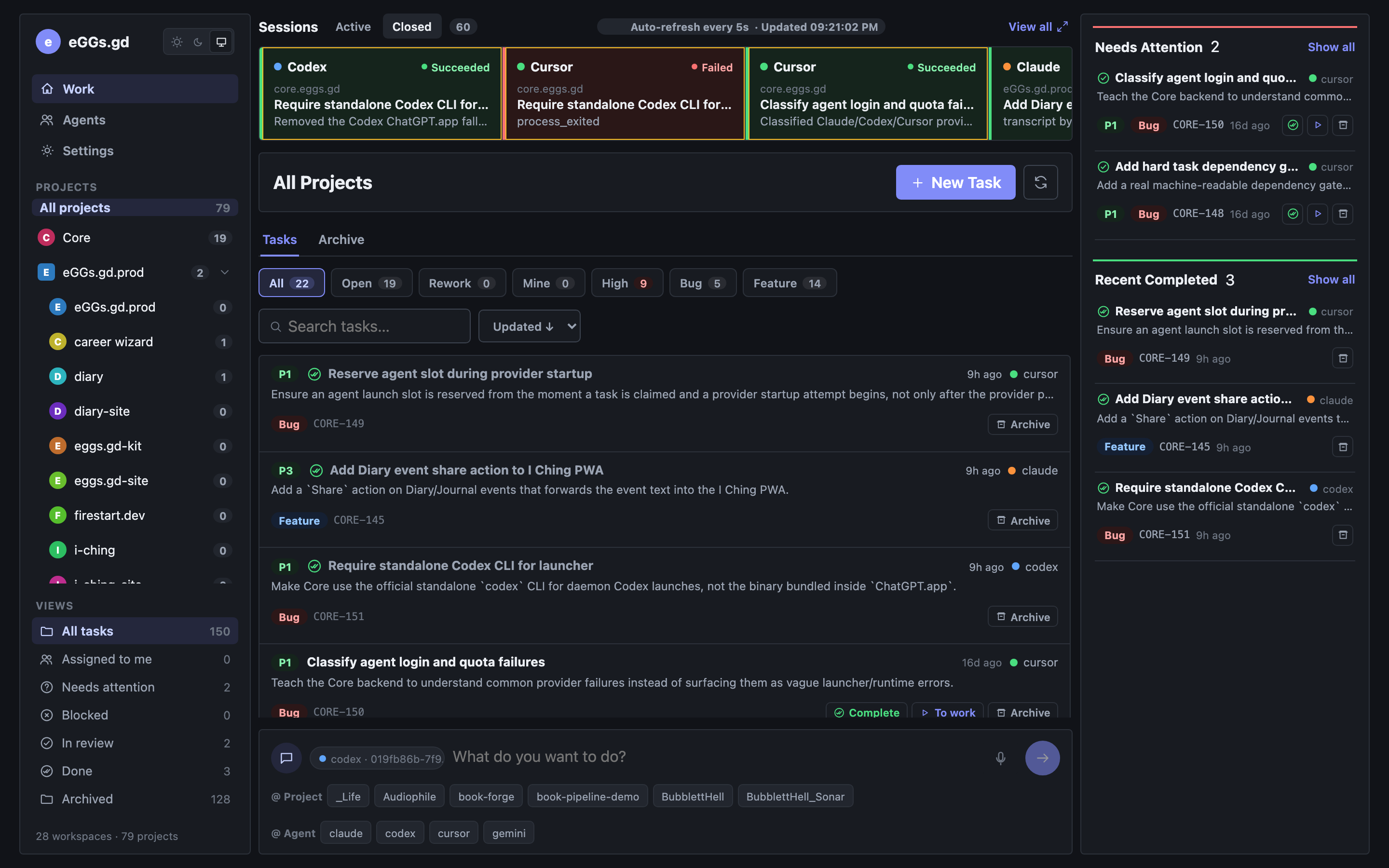
One place to see projects, tasks, sessions, ownership, attention, and review.
Run Fleet against your local projects and agents.
Fleet works with your local projects and the coding agents you already use.